It's funny how often barriers only get attention when something goes wrong.
Maybe pedestrians are walking through a work zone. A queue starts spilling into a busy walkway. Or an event entry point becomes a bottleneck because people aren't sure where they're meant to go. More often than not, the problem isn't a lack of barriers. It's choosing a barrier that wasn't designed for the job.
A retractable belt barrier organises queues in airports, retail stores and event venues, while temporary fencing panels create secure site perimeters on construction sites and restricted-access areas. Each barrier has a specific purpose, and choosing the right one makes planning and site management much easier.
As Australia's largest ramp retailer, Ramp Champ also supplies a wide range of safety barriers, including crowd control barriers, for construction sites, events, facilities management and public infrastructure projects. We've helped thousands of customers find solutions that suit their application.
In this guide, we'll explain the different types of crowd control barriers, where each one is used, their key features, and how to choose the right barrier for your site, project or event.
Why Does Choosing the Right Barrier Matter?
The right crowd control barrier does more than create a physical boundary. It helps people understand where they should and shouldn't go, making sites, events and public spaces easier to navigate and manage.
The right barrier:
- Improves pedestrian flow
- Defines walkways and restricted areas
- Supports traffic management and site access
- Reduces confusion for visitors, workers and contractors
- Creates a professional, well-organised site
From community events and public venues to construction sites and infrastructure projects, selecting the right barrier keeps people moving in the right direction while supporting the overall management of the site.
What Are Crowd Control Barriers?

Deploy steel barricades for heavy parade crowds.
Crowd control barriers are temporary or permanent systems used to guide pedestrian movement, restrict access to designated areas and separate people from worksites, hazards or vehicle traffic.
You'll see them at:
- Events and festivals
- Construction sites
- Roadworks
- Schools
- Sporting venues
- Shopping centres
- Transport hubs
- Public spaces
Each barrier type is designed for a specific application. Choosing the right barrier starts with understanding how it's used.
6 Types of Crowd Control Barriers and Their Uses

Select barriers based on specific project requirements.
Not sure where to start?
Here's a quick overview of the most common crowd control barrier types and where they are used.
Let's take a closer look at each option.
1. Expandable Barriers

Block unsafe escalators with expanding safety barriers.
A broken-down forklift, a cleaning spill, or maintenance work can quickly turn a busy area into a temporary hazard. Expandable barriers are portable safety barriers designed to block off these areas, helping direct people away while work is carried out.
Their concertina-style design expands to block off temporary hazards and folds away for compact storage, making them well-suited to warehouses, retail stores, schools and maintenance areas where barriers are regularly deployed and removed.
Best for:
- Temporary hazards
- Cleaning and maintenance work
- Warehouses
- Retail stores
- Schools
- Public facilities
Benefits:
- Expands and collapses for compact storage
- Quick to deploy and remove
- Easy to transport between locations
- Available in plastic and steel designs
-
Suitable for indoor and outdoor use
Things to consider:
- Designed for temporary barriers rather than securing large areas
- Multiple barriers are required for larger spaces
- Storage space should be planned when barriers are not in use
Plastic or Steel Expandable Barriers?
A plastic expandable barrier prioritises portability, making it easy to deploy, reposition and store between jobs.
A steel expandable barrier combines a robust steel construction with the same concertina-style design, making it a practical choice for higher-traffic environments that require a more durable temporary barrier.
When choosing between the two, consider where the barrier will be used, how often it will be moved and the level of pedestrian traffic in the area.
2. Water-Filled Barriers

Use high-visibility barriers to block hazardous zones.
If you've ever driven past roadworks or infrastructure upgrades, you've probably seen a water-filled barrier in action. These road traffic barriers are transported empty and filled with water once they're in position, making them easier to transport before installation while providing added stability once filled.
Best for:
- Roadworks
- Traffic management projects
- Infrastructure works
- Temporary lane closures
- Public works projects
Benefits:
- Filled on-site after placement
- Added stability once filled
- Available in a range of sizes and designs
- Suitable for outdoor environments
- Some systems can be linked together
Things to consider:
- Filling and emptying add to the setup time
- Requires access to a water source
- Larger storage and transport requirements
-
Installation requirements vary between products
Helpful Safety Tip: Before installation, check site-specific requirements and follow the manufacturer's instructions for setup and use.
3. Retractable Belt Barriers

Use stanchions to efficiently manage event queues.
A retractable barrier features self-retracting belts housed within a durable post, creating organised queues and directing pedestrian traffic in airports, retail stores, exhibition centres and public venues.
Best for:
- Queue management
- Airports and transport hubs
- Retail stores
- Reception areas
- Events and exhibition venues
Benefits:
- Quick to set up and reposition
- Helps create organised queue systems
- Compact footprint
- Designed for temporary crowd management
- Available in a range of belt colours and lengths
Things to Consider:
- Designed primarily for pedestrian guidance
- Larger spaces require multiple units
- Belts should be retracted carefully when not in use
When planning a queuing system, consider expected visitor numbers, accessibility requirements and the available space to ensure the barrier layout suits the application.
4. Pedestrian Barriers

Deploy high-visibility plastic barriers for heavy foot traffic.
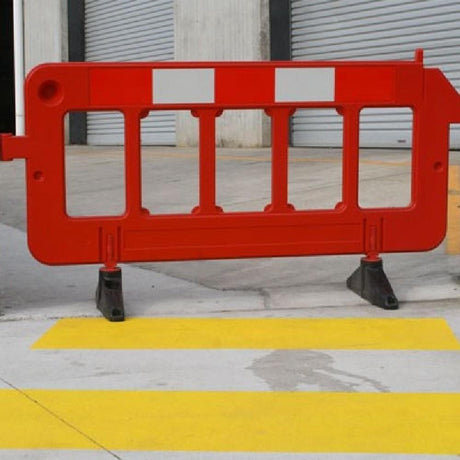
Pedestrian barriers feature an interlocking design that allows multiple barriers to be connected, making it easy to create temporary walkways, define pedestrian routes and restrict access to designated areas.
Best for:
- Roadworks
- Public events
- Temporary walkways
- Footpath diversions
- Transport hubs
Benefits:
- Creates clearly defined pedestrian routes
- Easy to reposition as site requirements change
- Available in a range of sizes and designs
-
Suitable for indoor and outdoor use
Things to Consider:
- Larger projects require multiple barriers
- Transport and storage should be planned
-
Designed to guide pedestrians rather than secure large areas
When planning pedestrian routes, consider expected foot traffic, site layout and access requirements to ensure the barrier system suits the application.
5. Steel Crowd Control Barriers

Utilise steel barriers for outdoor path delineation.
Steel crowd control barriers feature galvanised steel construction and interlocking hooks, allowing multiple barriers to be connected for longer crowd control runs. These durable protective barriers are designed for repeated deployment at concerts, festivals, sporting events and other high-traffic public venues where crowd movement needs to be clearly managed.
Best For:
- Concerts
- Festivals
- Sporting events
- Public gatherings
- Event entrances
Benefits:
- Durable steel construction
- Designed for higher pedestrian volumes
- Creates clearly defined boundaries
-
Interlocking design for longer barrier runs
Things to Consider:
- Heavier than some alternative barrier types
- Transport requirements should be planned
-
Larger layouts can increase setup time
When planning an event, consider expected crowd numbers, site layout and emergency access requirements to determine the number of barriers needed.
6. Temporary Fencing Panels

Install temporary fencing to secure event stages.
When you need to secure an entire site rather than guide pedestrian traffic, temporary fencing panels create a defined perimeter and help control access to designated areas. Installed with temporary fencing feet and clamps, they form freestanding site perimeters that can be expanded, reconfigured and removed as project requirements change.
Best for:
- Construction sites
- Infrastructure projects
- Event perimeters
- Restricted-access areas
- Longer-term projects
Benefits:
- Creates a clearly defined site boundary
- Helps control access to designated areas
- Suitable for larger sites and work areas
- Available in a range of panel sizes and configurations
- Can be installed and removed as project requirements change
Things to Consider:
- Requires more space than some barrier types
- Installation takes longer than setting up individual barriers
- Additional components such as feet, clamps or stabilisers are required
-
Transport and storage should be planned
Temporary fencing panels are commonly used where access needs to be controlled for the duration of a project or event.
Helpful Safety Tip: Before installation, check site-specific requirements and follow the manufacturer's instructions for setup and use.

Select the ideal barrier based on its specific location and intended application.
How Do You Choose the Right Crowd Control Barrier?

Interlocking steel barriers create secure crowd control.
Choosing the right safety barrier starts with understanding your application, environment and project requirements.
Start with the Application
Think about what you're trying to achieve.
- Managing queues? Use a retractable belt barrier.
- Directing foot traffic? Use an interlocking crowd control barrier.
- Managing large crowds? Use steel crowd control barriers.
- Securing a worksite? Install temporary fencing panels.
- Managing roadwork? Use a water-filled barrier.
- Blocking off a temporary hazard? An expandable barrier is designed for the job.
Match the Barrier to the Environment
Will the barrier be used indoors or outdoors? Weather conditions, available space and expected pedestrian or vehicle traffic all influence which barrier is best suited to the application.
Plan for Setup and Storage
If barriers need to be moved regularly, look for products that are easy to transport, deploy and store.
Consider:
- Weight
- Setup time
- Storage requirements
- Transport logistics
Match the Barrier to the Project Duration
A one-day event has different requirements from a six-month construction or infrastructure project. Choose a barrier that's designed for the expected duration and how often it will need to be relocated.
Look Beyond Upfront Cost
Price is only one part of the decision. Also consider product durability, ease of deployment, storage requirements and how frequently the barrier will be used.
Frequently Asked Questions

Use retractable belt stanchions for indoor queuing.
What is the most common type of crowd control barrier?
Interlocking crowd control barriers are widely used because they guide foot traffic and create temporary walkways at events, roadworks and public spaces.
Are water-filled barriers suitable for roadworks?
Yes. Water-filled barriers are designed for roadworks, traffic management and infrastructure projects. They're transported empty and filled on-site to provide added stability.
What's the difference between a pedestrian barrier and temporary fencing?
Pedestrian barriers guide foot traffic and define temporary walkways. Temporary fencing panels create a site perimeter and help control access to restricted areas.
Can crowd control barriers be used indoors?
Yes. Retractable belt barriers and expandable barriers are commonly used indoors in retail stores, schools, airports, warehouses and public facilities.
Which crowd control barrier is best for events?
Different barriers are used for different event requirements. Steel crowd control barriers help manage large crowds, pedestrian barriers guide foot traffic, and retractable belt barriers organise queues and entry points.
Finding the Right Barrier for the Job

Use retractable barrier to secure temporary access points.
Every project has different crowd management requirements. The key is choosing a barrier that's designed for your application, environment and expected pedestrian or vehicle traffic.
At Ramp Champ, we stock a wide range of safety barriers, including expandable barriers, water-filled barriers, retractable belt barriers, crowd control barriers, steel crowd control barriers and temporary fencing panels.
Explore our range of crowd control barriers to compare products and find the right solution for your site, event or project.