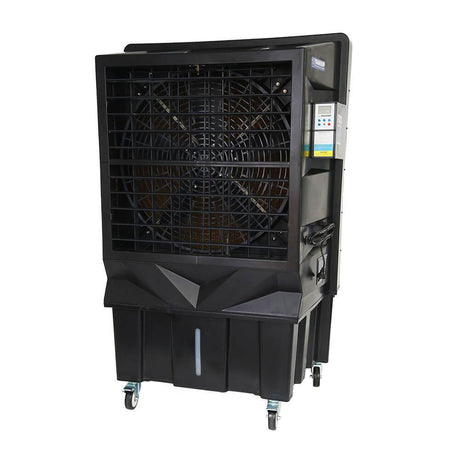
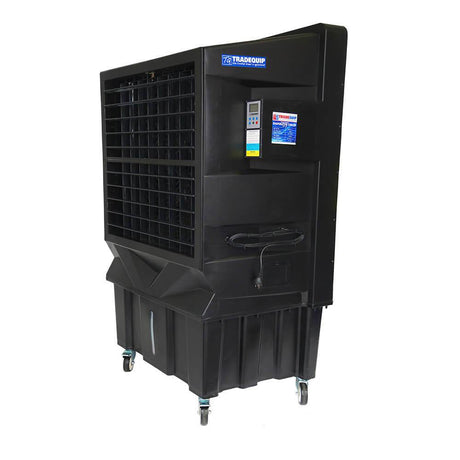
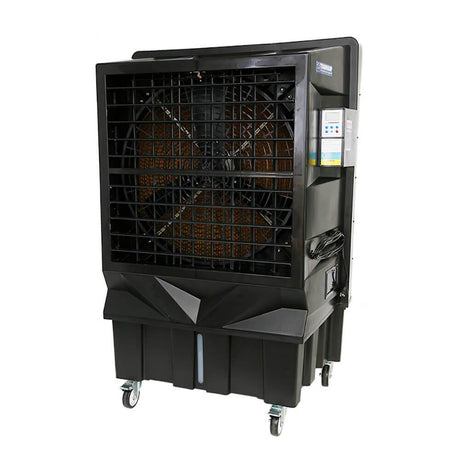
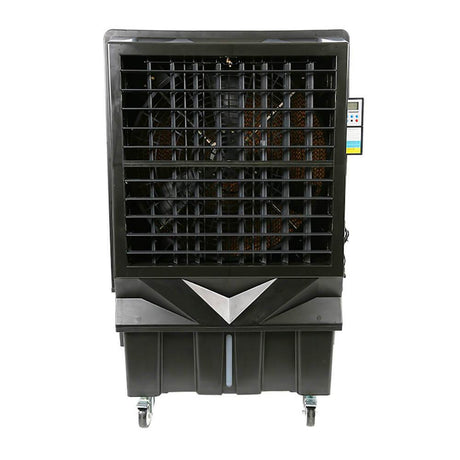
If you’re trying to cool a hot workshop, garage or industrial space, without blowing out your power bill, you’ve probably come across evaporative coolers.
They’re often mentioned as a low-cost, low-power cooling option, but it’s not always clear how they work or how they compare to fans and air conditioners. Choosing the wrong size can also lead to disappointing results.
This guide breaks it down simply. We’ll explain what an evaporative cooler is, how it works and how to choose the right size so you get effective cooling that suits your space.
What Is an Evaporative Cooler?
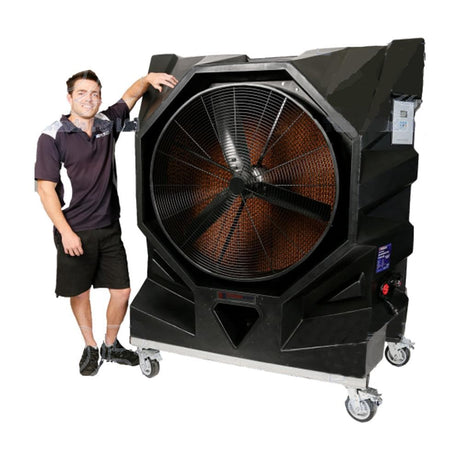
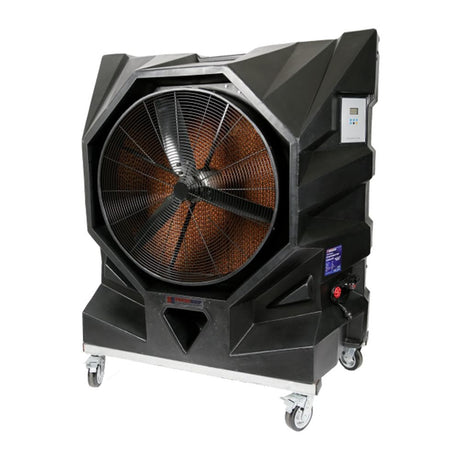
An evaporative cooler is a portable cooling unit that uses water and airflow to bring the temperature down. Instead of relying on compressors or refrigeration like a typical air conditioner, it works with a natural process.
Because there are no heavy-duty parts or complex systems involved, evaporative coolers are known for being low-cost to run and gentle on power. They also create a fresh, breezy feel rather than the cold, closed-off air you get from an air conditioner.
This makes them a popular choice for large, open spaces where traditional air conditioning isn’t practical or cost-effective. Think of it as a simple, natural way to get relief from the heat, especially in dry, hot Australian conditions.
How Does an Evaporative Cooler Work
 An evaporative cooler works by pulling warm air through water-soaked pads. As the air moves through, the water starts to evaporate, which naturally drops the temperature. A fan then pushes that cooler air back into your space. The result is a steady flow of cooler, fresher air without the heavy energy use of refrigerated cooling.
It’s a simple process that doesn’t rely on gas, refrigeration, or heavy machinery. All it needs is water, airflow, and a bit of power to run the fan and pump.
Because of that, evaporative coolers use far less energy than traditional air conditioners.
The key thing to remember is that they work best with fresh air coming in and out. A bit of ventilation helps the system do its job properly and keeps the air feeling crisp rather than stuffy.
Pros and Cons of Evaporative Coolers
Before deciding if an evaporative cooler is right for you, it helps to understand what they do well and where they may fall short. Here’s a simple breakdown.
Pros
- Low running costs
- Fresh, continuous airflow
- Simple maintenance
- Environmentally friendly
- Effective in dry heat
Cons
- Less effective in humid areas
- Requires some ventilation
- Cooling is milder than an air conditioner
Is an Evaporative Cooler Right for Your Space?

If you’re weighing up whether an evaporative cooler is the right solution, these three factors will help you decide quickly.
Evaporative coolers work well in many situations, but they’re not the perfect fit for every space. Before choosing a size, it helps to know whether an evaporative cooler will suit the area you’re trying to cool.
Assess Your Climate Conditions
Evaporative coolers perform best in dry, hot conditions. If you live somewhere with low humidity, you’ll get the strongest cooling effect. In very humid areas, the air already holds a lot of moisture, which can make evaporation less effective.
Great for Large Workspaces
One standout benefit is that they don’t need much power to run, making them ideal for workshops, garages, and industrial areas where you need strong airflow without overloading your power supply. An evaporative cooler can keep large spaces more comfortable while using less energy than traditional cooling systems.
Consider Airflow and Ventilation
Evaporative coolers work best when there’s fresh air flowing through the space. A slightly open window or door is usually enough to help move warm air out and keep the cooler air circulating.
What Size Evaporative Cooler Do You Need?

The easiest way to choose the right size is to figure out the volume of your room. Multiply the length, width and height to get the space in cubic metres. This helps you compare your space to the cooler’s airflow rating.
How Evaporative Coolers Are Measured
Evaporative coolers are measured by how much air they can move. In Australia, this is usually shown as m³/hr, while some overseas brands use CFM. Both measurements describe the same thing: airflow.
A higher airflow rating suits bigger spaces or rooms with higher ceilings. Smaller ratings work well for compact workshops or single-bay garages.
If you see CFM, the rule is simple: the higher the number, the more air the cooler can move. Just match the airflow rating to the size of your space.
General Airflow Guide
Here’s a quick way to match airflow to common setups:
- Small areas like single-bay garages or compact workstations usually need around 1000 to 3000 m³/hr.
- Medium spaces such as standard workshops or multi-bay garages often suit 4000 to 8000 m³/hr.
- Larger areas like big sheds, warehouses or industrial workshops with high ceilings may need 9000 m³/hr or more.
Sizing an evaporative cooler is one of the most important steps. If your cooler is too small, the temperature change will be minimal. Too large, and you may use more power and water than you need without improving comfort. Getting the right size makes a noticeable difference.
If you’re unsure, choosing slightly higher airflow is usually better than undersizing, especially for open or high-ceiling spaces.
Evaporative Cooler vs Air Conditioner vs Fan
If you’re looking for a cooling option that’s affordable to run, gentle on power and better for air quality, evaporative coolers often come out ahead. They bring in fresh air, use far less energy than an air conditioner and deliver more cooling than a standard fan.
For workshops, sheds and garages in dry climates, evaporative coolers often offer the best balance of comfort, cost, and airflow.
Comparison Table

FAQs on Evaporative Coolers
Q: How effective are evaporative coolers?
A: They work very well in hot, dry conditions and can noticeably lower the temperature, but they’re less effective in humid weather.
Q: Do evaporative coolers use a lot of electricity?
A: No, they use very little power because they only run a fan and a small water pump, making them far cheaper to operate than air conditioners.
Q: Do I need to open my windows to use an evaporative cooler?
A: Yes, a window or door should be slightly open so warm air can escape and cooler air can circulate.
Q: What kind of water should I use with an evaporative cooler?
A: Regular tap water is fine. Hard water may cause more mineral build-up, but it won’t affect basic operation.
Q: Are evaporative coolers suitable for workshops and garages?
A: Yes. They're well-suited to workshops, garages, and sheds because they handle large spaces well and don't require sealed rooms like air conditioners.
Q: How often should evaporative cooler pads be changed?
A: Pads typically need replacing every one to two seasons, or sooner if they become worn or heavily coated in mineral build-up.
Conclusion

Choosing the right evaporative cooler doesn’t need to be complicated. Once you understand how they work and how to match airflow to your space, it’s much easier to choose a model that delivers real comfort in hot conditions.
Evaporative coolers are affordable to run, easy to maintain, and ideal for workshops, garages, and industrial spaces in dry Australian climates. If you’re unsure which size or model suits your setup, our team can help point you in the right direction.