Ramp Calculator
How steep is your ramp? Put in the height you're climbing and the length of the ramp, and you'll get the angle straight away. Tell us what you're moving up it and we'll also tell you whether that angle actually works, and how long a ramp you need.
Tell us and we'll say whether that angle actually works, and which ramp you need.
Change either number and this updates as you type. To find out whether 14.5° is any good, and which ramp you need, tell us what you're moving.
What is a safe ramp angle?
It depends what's going up it. A wheelchair needs 1:14 by law. A dog is fine at 18 degrees. A motorbike is built to run at 22. There is no single safe angle, which is why the calculator asks what you're moving before it gives you a verdict.
Wheelchair ramps and the Australian standard
The Australian standard for access ramps is AS 1428.1:2021. For an occupied wheelchair with nobody pushing, the maximum gradient is 1:14. That means 14 units along for every 1 unit up, so a 600 mm rise needs 8.42 m of ramp.
| What you're moving | Aim for | Where the number comes from |
|---|---|---|
| Wheelchair, nobody pushing | 4.1° (1:14) | AS 1428.1:2021, the Australian standard. More |
| Wheelchair, someone pushing, or one small step | 5.7° (1:10) | AS1428.1 step ramp. More |
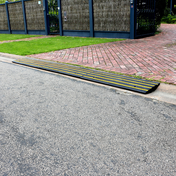
| Doorway threshold, up to 35 mm | 7.1° (1:8) | AS1428.1 threshold ramp. More |
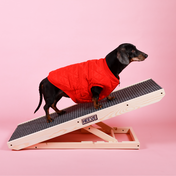
| Dog: older, small or sore | 18° | Comfort. Too steep is the top reason dog ramps come back. More |
| Dog: young and able | 25° | Comfort. More |
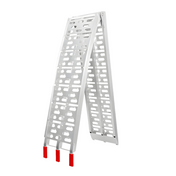
| Bike, ATV or ride-on mower | 22° | The angle these ramps are built to run at. More |
| Car onto a trailer | 10° | Ground clearance at the crest, not power. More |
| Trolley, removals, livestock | 15° | Comfortable to push a load up. More |
| Excavator, skid steer, plant | 23° | Ramp Champ's loading guide. More |
| Forklift, container, dock | 12° | Ramp Champ's forklift guide. More |
Gradient is only half of it. At 1:14 the standard also wants a landing every 9 m of run, and 9 m of run at 1:14 is a rise of about 643 mm. So a low step, a car boot or a van floor is one straight ramp, but a typical 900 mm house entry needs 12.6 m of run, which is two flights with a 1200 mm landing between them, not one long ramp. The calculator tells you the moment your run goes past 9 m, because it changes what you're buying, not just how long it is.
One more honest limit: this tool checks the gradient, and the gradient is what most people get wrong. Full compliance also covers landings, clear width, handrails both sides, surfaces and edge protection. And AS 1428.1 is written for new building work under the National Construction Code, so it doesn't strictly govern a private home at all, it's the benchmark everyone sensibly builds to. A signed off installation still needs an OT or a building certifier.
Dog ramps: keep it under 18 degrees
There's no standard for dog ramps, so we go on what works. Ramp Champ's own guide puts it plainly: a dog ramp gradient should be no more than 25 degrees. That's the ceiling for a young, able dog. For an older, smaller or post operative dog we aim gentler, at or under 18 degrees, because the dogs that struggle are the ones the ramp was bought for. A 600 mm car boot needs about 1.94 m of ramp to sit at 18 degrees.
Too steep is the single most common reason a dog ramp gets sent back.
Bike, ATV and mower ramps: about 22 degrees
Purpose-built drive-up ramps are built to run at about 22 degrees, and up to 30 degrees is doable with good grip. There's no legislated figure for loading, so this is a working range, not a compliance line.
Car ramps: 10 degrees, or you'll scrape
Cars onto trailers need a much shallower slope, around 10 degrees. The limit isn't power, it's ground clearance at the crest where the ramp meets the deck.
Plant, machinery and forklift ramps
Ramp Champ's own loading guide puts plant and machinery between 16 and 23 degrees. Forklifts are different: the forklift guide recommends no more than 12 degrees. If you know your machine's rated climb off its spec plate, put it in and the calculator will size to that instead.
What length ramp do I need?
It depends on the height you're climbing and what's going up. For a wheelchair at the Australian standard of 1:14, a 600 mm rise needs 8.42 m of ramp. Put your height into the calculator and it gives you the length for your exact case.
What is the maximum ramp gradient under AS 1428.1?
1:14 for a main ramp used by an occupied wheelchair. Steeper than that does not meet the standard. Step ramps (rise up to 190 mm) may be 1:10. Kerb ramps (up to 190 mm) and threshold ramps at a doorway (up to 35 mm) may be 1:8. Anything 1:20 or gentler counts as a walkway, not a ramp.
What happens if my ramp angle is too steep?
For a wheelchair, it won't meet the standard and won't pass an inspection. For loading, a ramp steeper than the working range risks the load grounding out at the crest or the machine losing traction. The fix is always the same: a longer ramp for the same height gives a shallower angle.
What angle is safe for a dog ramp?
Ramp Champ's guide says a dog ramp gradient should be no more than 25 degrees. For an older, smaller or post operative dog, aim gentler, at or under 18 degrees.
This calculator sizes ramps on gradient. Full AS 1428.1 compliance also covers landings, width, handrails and surfaces. A signed off installation still needs an OT or a building certifier.